
Musical Alphabet
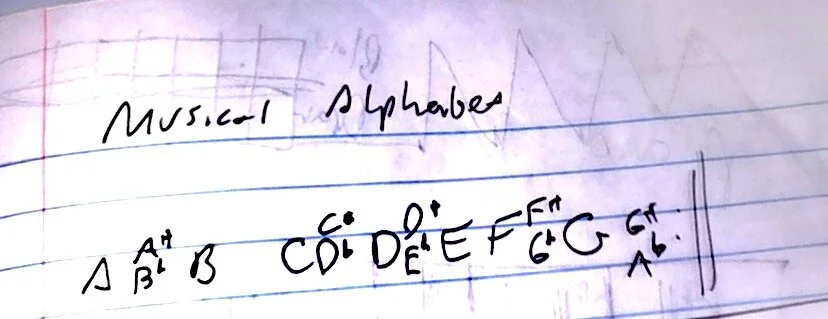
Over my many, many years of teaching I have encountered students of all ages, experience, musical preference, and education, and if there’s one thing that always (while also never) surprises me, is how many people beyond the beginner stage do not know or lean heavily on the importance of the musical alphabet.
Something so rudimentary, and so crucial, and somehow many teachers overlook the need to stress the value of this simple piece of info.
If you think about it in terms of utilizing a language like English, we absolutely rely on the alphabet to read, write, and even vocalize. The letters all have power in their sounds, and the combinations of letters that can convey so many different things from dialect, and slang. It’s really all about the underlying need humans have to communicate with each other. Birds may sing to one another, and dolphins may have a language of their own, but what sets humans apart is that we write things down, and read,.. This evolutionary gift that we have been granted.
So it stands to reason, that we as humans utilize this gift to convey our musical language.
ALL humans have innate musical ability, no different than other birds and beasts. We have the natural ability to make pitches and rhythms that create our own unique expressions. We can record these “conversations”, and that is what makes us so special. And we can share them without the aid of understanding and reciprocating in the moment or based exclusively on deep brain instinct or habit. It makes me wonder; do birds know that they are being musical, or do they just do what they do?..
If they had an alphabet and the ability to write and read.. What would they learn?..
I digress. We are not birds, so let’s refocus on the topic at hand : the musical alphabet.
Know The Language
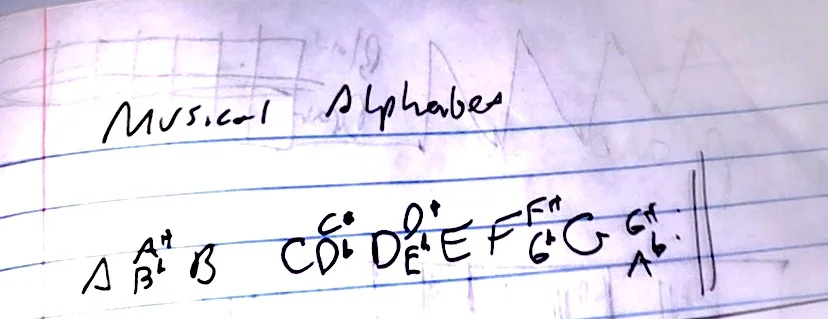
Here is the musical alphabet, for those that need it
A A# B C C# D D# E F F# G G# A
Bb Db Eb Gb Ab
The stacked notes are enharmonic equivalents, meaning in simple terms that they are the same pitch, but differently named based on context.
All black keys on a piano are doubly named. All white keys “can” be doubly, or even triply named, but when you get into that you are dealing with some more avant garde keys, ones that are not nearly as common in pop, rock, country, and/or other western based genres.
This alphabet is important because it is used to create single note melodies, multi-note harmonies, chord triads, and really everything else we do in music. Take note that this is a western based system; in the east they use different tonal systems and they utilize microtones and other “in between” pitches unique to their respective regions. For this blog we will focus on the western system only.
Why Does The Musical Alphabet Get Left Behind
I think that a lot of people, including many teachers don’t lend credence to the importance of having a solid grip on the alphabet. Perhaps this is due to laziness, or maybe it’s because one doesn’t “have” to know their theory as a result of bad example setting by rock stars. SO many players I have encountered lean on the statement “ I don’t know how to read music, but I don’t need to.. Jimi Hendrix didn’t read music..”.. I actually have heard this more times than you can imagine. It is NOT a justifiable reason to be ignorant to important rudimentary concepts, especially one as basic and necessary for advancement and evolution as a student of music.
With my students, no matter how old, how advanced, or how knowledgeable they say they are, the musical alphabet is always the number one thing I test when we sit down for a first session. Like I said above, it’s amazing how many accomplished players and writers have NO clue how to empower themselves with the alphabet. It is the KEY to all things as far as the music is concerned, and it is applicable to just about all western instruments, and of course, voice.
Practice It Even When You Don’t Think You Need To
I remember a time when I was teaching a student, and he was not a newbie, but I had him writing down 5 alphabets at the start of each lesson, and one day he says “I don’t get why you still make me do this every week,.. Do YOU still do this?”; and to that I replied “I write at least one alphabet down per lesson, and I teach up to 6 lessons in a day, multiple days a week.. So yes, I do still write the alphabet daily. And I’m better for it”. This is the truth.. Despite knowing it inside and out, just the simple action of revisiting it daily deepens my connection and utilization of it as a tool. It’s like a prayer I recite before starting my musical day, and it continues to aid me as my perception of its versatility evolves. Just like with the standard English language alphabet, and how it is the premise of all words, sentences, and vocalizations, the musical alphabet is equally important for having a reliable musical vocabulary.
ABC, It’s As Easy As 123…
The musical alphabet is simple. Memorize it, write it out over and over as if it were a mantra; really immerse yourself in it, and the rest will come naturally. Faster, more guided improvisation, more efficient recitation and replication of sheet music, more advanced comprehension of harmony and melody.
Add it to your daily practice and see what comes of it. I am 100% certain that it will benefit your skill set and open many doors to next level musicality.
Give it a try right now: after you finish reading this, get some paper and a pen, and write out 10 alphabets. Just for the sake of the practice. Then do this again every day for one month. Analyze your reading, performing, and improvising before and after.. Take note of what you observe in your comfort level.
There you have it, my perspective on the importance of the musical alphabet.
Till next time, Be well.
JCMW on Instagram
Suggested Blogs for You





“Finding band members is much like dating. You somehow meet, you arrange a time and place to get acquainted, you share common interests, and then if it goes well, you make more plans.
It’s a dance, and if it’s a good dance, it can turn into a long term thing…”